Bourbon vs. Whiskey: What’s Actually the Difference?
Walk into any bar, and you’ll see bourbon and whiskey listed as though they’re two different drinks. They aren’t. Bourbon is whiskey, in the same way a golden retriever is a dog. What makes it bourbon is a specific set of rules about how it’s made.
Those rules are written into US federal law, which means “bourbon” on a label isn’t marketing; it’s a legal claim the distillery has to be able to back up.
Bourbon is a type of whiskey. To be called bourbon, a spirit must be made in the United States from a grain mix that’s at least 51% corn, aged in new charred oak containers, and bottled at no less than 80 proof. Whiskey is the broader family that also includes rye, scotch, Irish whiskey, and more.
What Is Whiskey?
Whiskey is any spirit distilled from fermented grain and aged in wood. That’s the whole definition. The grain can be corn, rye, barley, wheat, or a mix. The wood can be new or used, charred or not, depending on what’s being made and where.
Anything else – bourbon, rye, scotch, Irish, Tennessee, Japanese – is a subcategory with its own rules layered on top.
What Makes a Whiskey a Bourbon?
American law sets out what a distillery has to do before it can put “bourbon” on a label:
- Made in the United States. Not just Kentucky. Bourbon can legally be made in any state, and it is—Pennsylvania included.
- At least 51% corn in the grain bill. Most bourbons run higher, often 60–75%, with rye or wheat and malted barley making up the rest.
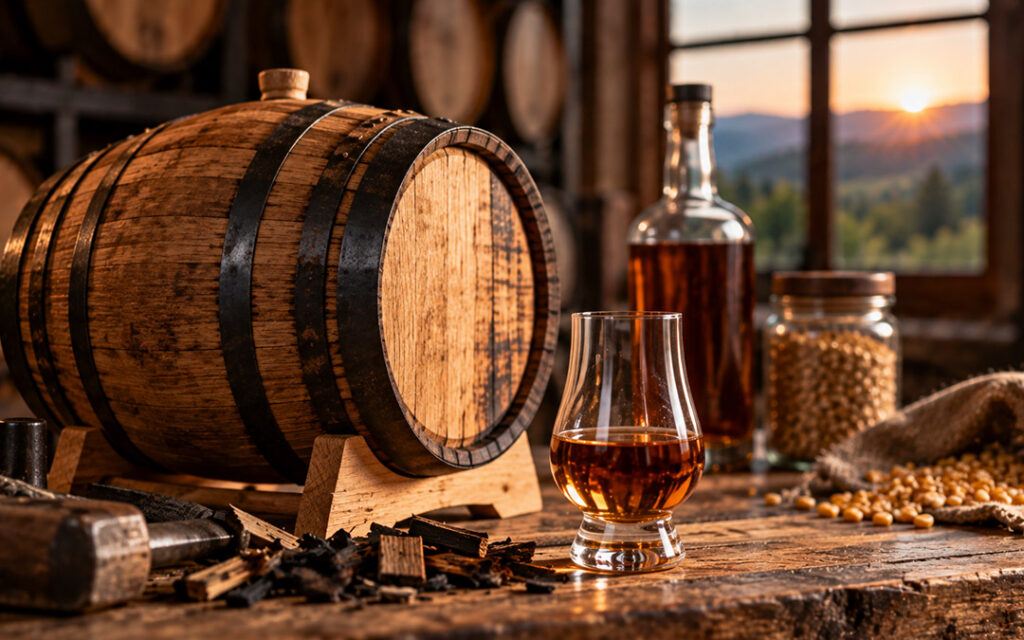
- Aged in new, charred oak containers. New is the key word. A barrel can only be used for bourbon once, which is why used bourbon barrels get sold on to scotch, rum and beer producers afterwards.
- Distilled to no more than 160 proof, entered into the barrel at no more than 125 proof, and bottled at no less than 80 proof.
- Nothing added except water to bring the strength down. No coloring, no flavoring.
There’s no minimum aging period for plain bourbon. “Straight bourbon” is the term that requires at least two years in the barrel.
Why Bourbon Tastes Sweeter Than Rye Whiskey
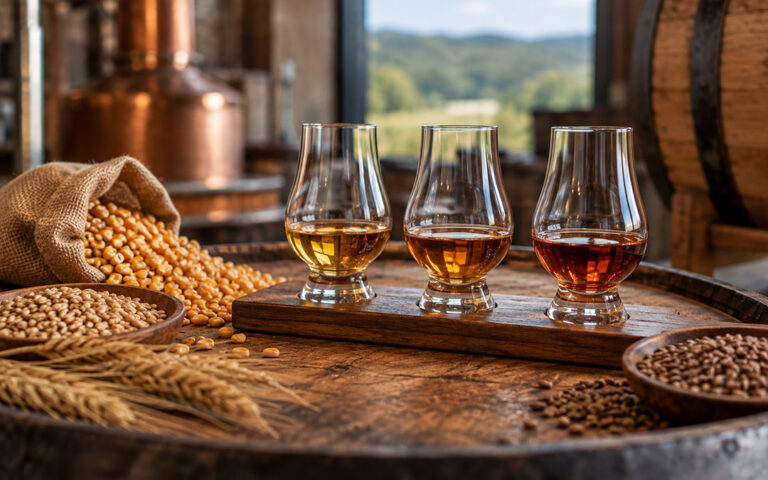
Corn is sweet, and that sweetness carries through distillation. It’s the reason bourbon tastes rounder and softer than a rye whiskey made the same way. Caramel, vanilla, and brown sugar notes come partly from the corn and partly from the new charred oak, which gives up far more flavor than a used barrel would.
Swap the majority grain to rye and the whole character shifts—drier, peppery, with a sharper finish. Same process, different result.
Does Bourbon Have to Come From Kentucky?
Bourbon does not have to come from Kentucky. Around 95% of it does, which is how the association stuck, but the law says the United States and nothing narrower.
Pennsylvania has its own claim here. Western Pennsylvania was the center of American whiskey production long before Kentucky was, and rye was the grain of choice. The Whiskey Rebellion of the 1790s happened in this part of the state precisely because there was so much whiskey being made here.
Bourbon vs. Rye vs. Scotch, Compared
| Bourbon | Rye Whiskey | Scotch | |
|---|---|---|---|
| Main Grain | At least 51% corn | At least 51% rye | Malted barley |
| Where | United States | United States | Scotland |
| Barrel | New, charred oak | New, charred oak | Usually used barrels |
| Character | Sweet, round, vanilla and caramel | Dry, peppery, spiced | Varies; often malty or smoky |
| Minimum Age | None (2 years for “straight”) | None (2 years for “straight”) | 3 years |
Taste the Difference Yourself
The fastest way to understand the difference is to taste them next to each other. Pour McLaughlin’s 3799 Bourbon alongside our Blackburn Rye, and the corn-versus-rye distinction stops being theoretical within about thirty seconds.
If you’d rather have someone walk you through it, our distillery tours in Pennsylvania run seven days a week and end with a guided tasting across the range.
Frequently Asked Questions
Below are some commonly asked questions to consider:
Is it all bourbon whiskey?
Yes. All bourbon is whiskey; not all whiskey is bourbon.
Does bourbon have to be from Kentucky?
No. It has to be made in the United States. Kentucky produces most of it, but that’s history and industry concentration, not law.
What does “straight bourbon” mean?
Bourbon aged at least two years. If it’s aged less than four years, the label has to state the age.
Is Tennessee whiskey bourbon?
It meets the bourbon requirements but adds a charcoal filtering step before barreling, and producers there generally choose to label it Tennessee whiskey instead.
Why is bourbon sweeter than rye?
Corn. It’s the majority grain in bourbon, and it carries sweetness through the still and into the barrel.